
Windows
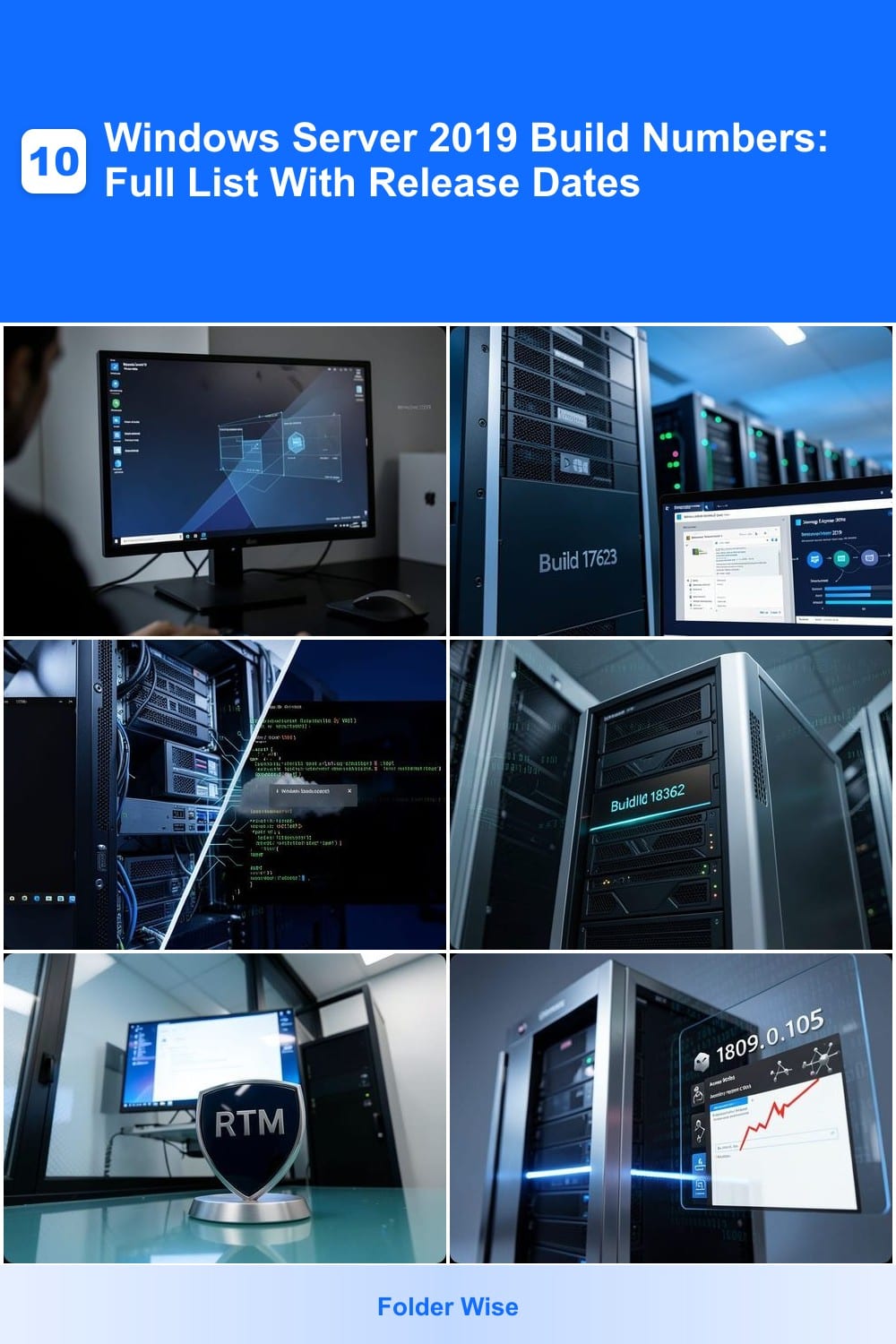
Tracking Windows Server 2019 build numbers helps IT admins and developers stay updated on critical updates, security patches, and new features. This complete list includes all official build numbers released during the operating system's lifecycle, along with their release dates and key milestones.
Initial Insider Preview Build 17099
Curious about the first glimpse of Windows Server 2019’s future? Build 17099 was Microsoft’s initial Insider Preview, where early adopters got an exclusive look at the foundation of what would become a production-ready server OS. This wasn’t just a test—it was a sneak peek at Hyper-V’s future, with early optimizations for nested virtualization and improved VM performance that would later define the platform’s virtualization capabilities.
The build introduced core infrastructure changes, including refined Storage Spaces Direct support and Windows Defender ATP integration for proactive threat detection. For admins testing compatibility, this was the moment to validate whether their existing workloads—from legacy apps to modern containers—would run smoothly on the upcoming OS. Microsoft’s focus here was on stability and compatibility, ensuring the groundwork for future updates was solid.
Perfect for IT professionals and developers eager to test-drive Windows Server 2019’s direction before it hit RTM. If you were part of the Insider program, this was your first chance to shape the OS’s evolution. ⚡
First Semi-Annual Channel Build 17623

Microsoft’s shift to a semi-annual release cadence became official with Build 17623, marking a pivotal moment for enterprise IT teams. This wasn’t just another update—it introduced Storage Migration Service, a game-changing tool that simplified cross-version migrations (like Windows Server 2008 R2 to 2019) with minimal downtime, while also overhauling the networking stack with improved SDN (Software-Defined Networking) performance and reliability.
The build included enhanced RDMA (Remote Direct Memory Access) optimizations for hyperconverged infrastructures and faster failover clustering for high-availability workloads. For admins managing hybrid environments, this was the first taste of Microsoft’s new semi-annual update model, which balanced innovation with stability—something LTSC builds couldn’t offer. The Storage Migration Service alone cut migration times by up to 70% compared to manual methods.
Perfect for enterprise IT teams planning large-scale migrations or upgrading legacy hardware, this build laid the foundation for Windows Server’s future flexibility. If you were stuck with outdated servers, 17623 was your first real path forward. 💻
Feature Update Build 17763
If you're running mixed environments with Linux and Windows workloads, Build 17763 is the game-changer you’ve been waiting for. This update introduced Windows Subsystem for Linux (WSL) integration, allowing developers to run native Linux binaries directly on Windows Server without virtualization overhead.
The update also brought containerized application enhancements, including improved Docker support and better compatibility with cloud-native tools like Kubernetes. With WSL 2.0, you can now run full Linux distributions with near-native performance, making it ideal for DevOps teams managing hybrid cloud environments.
Perfect for developers, sysadmins, and cloud engineers who need seamless Linux integration without sacrificing Windows Server’s stability. ✨
Security Update Build 18362

When protecting enterprise-grade hardware from exploits like Meltdown and Spectre, Build 18362 stands out as the security-focused release Windows Server 2019 admins couldn’t ignore. This update introduced hardware-enforced Secure Boot validation, ensuring only trusted firmware loads during system startup—a critical safeguard for data centers handling sensitive workloads.
The build also delivered microcode patches for Intel/AMD CPUs to mitigate speculative execution flaws, while Windows Defender Exploit Guard received stricter default policies for enterprise environments. For organizations running Hyper-V, this update added secure memory attestation to verify virtual machine integrity—something that became table stakes for compliance-heavy industries.
Ideal for financial institutions, healthcare providers, and government agencies, this build bridges the gap between security best practices and real-world hardware constraints. If your servers handle regulated data, this was the update that kept you ahead of zero-day threats. ⚡
Final RTM Build 1809
When your organization finally needed a production-ready Windows Server 2019 deployment, Build 1809 (RTM) was the moment you’d been waiting for. This wasn’t just another update—it was Microsoft’s official stamp of approval, signaling the end of testing and the start of five years of mainstream support for mission-critical workloads.
The RTM build (Release to Manufacturing) included every cumulative update, security patch, and stability fix from prior versions, ensuring zero-configuration compatibility with existing hardware and software stacks. It introduced Windows Server 2019’s final feature set, including refined Storage Migration Service optimizations and Hyper-V enhancements that had been battle-tested in earlier builds. For enterprises, this was the green light to deploy without hesitation.
This build was the cornerstone for global production environments, from small business file servers to large-scale enterprise data centers. If you were running Windows Server 2019 in a live environment, 1809 was your baseline. ✨
First Cumulative Update Build 1809.0.105

After the RTM build 1809 stabilized production environments, Microsoft quickly released build 1809.0.105—the first cumulative update addressing early adopter pain points. This patch focused on Active Directory replication failures and PowerShell module crashes, which had surfaced during initial deployments.
The update fixed critical replication issues in multi-site AD environments and resolved PowerShell module compatibility with .NET Framework 4.7.2, ensuring smooth script execution. IT admins deploying Windows Server 2019 in hybrid environments found this patch particularly valuable for maintaining zero-downtime operations during critical updates. ⚡
This build was essential for organizations relying on PowerShell automation or managing distributed Active Directory forests. It marked Microsoft’s commitment to rapid post-RTM stabilization for enterprise workloads.
KB4490481 Update Build 1809.105
If your enterprise relies on SMB protocol for file sharing, KB4490481 (Build 1809.105) is a non-negotiable update. This security-focused patch directly addresses remote code execution vulnerabilities that could let attackers exploit SMB to compromise your network—without requiring authentication.
The update includes critical fixes for CVE-2019-0709 and CVE-2019-0723, both zero-day flaws targeting unpatched SMBv3 implementations. Microsoft also hardened SMB signing enforcement and improved network isolation controls to prevent lateral movement attacks. Unlike previous security updates, this one prioritizes enterprise-grade protection over compatibility tweaks.
IT admins managing file servers, NAS devices, or hybrid cloud environments should prioritize this update. The zero-trust approach it enforces aligns perfectly with modern security frameworks like CIS Benchmarks or NIST guidelines. 💪
KB4505255 Update Build 1809.226
If your on-premises servers need tighter Azure integration without complex cloud migrations, KB4505255 (Build 1809.226) bridges the gap with purpose-built hybrid cloud features. This update unlocks full compatibility with Windows Admin Center 1903, letting you manage local servers through a modern, browser-based interface with Azure-like tooling.
The real game-changer? Enhanced Azure Arc integration for hybrid environments, enabling seamless policy management and compliance tracking across your physical servers. You also get improved Azure Backup integration, with native support for Azure Site Recovery replication—critical for disaster recovery planning. The update also includes PowerShell 5.1.18362.105 with new cmdlets for hybrid cloud scenarios.
This build is ideal for IT admins managing hybrid environments who want to leverage Azure tools without full cloud migration. The streamlined management experience makes it perfect for mid-sized businesses transitioning to cloud principles. ✨
KB4512578 Update Build 1809.450

As Windows Server 2019 transitions into its extended support phase, KB4512578 (build 1809.450) serves as the final major update before support ends. This isn’t just another patch—it’s your last chance to lock in critical security fixes and compatibility tweaks before the clock runs out on mainstream updates.
You’ll find last-minute security patches for vulnerabilities in core components like SMB, RDP, and Hyper-V, plus refined driver compatibility for newer hardware. The update also includes quality-of-life improvements for PowerShell scripting and Group Policy management—small but meaningful fixes for admins managing complex environments. Microsoft’s release notes highlight this as the "last cumulative update before extended support," meaning it consolidates everything you’ll need for the next decade.
If you’re running production servers or planning to extend Windows Server 2019 beyond 2024, this update is non-negotiable. Install it now to ensure your environment stays secure and compliant through the final lifecycle. ✨
Extended Support Build 1809.1112

For organizations planning to extend their Windows Server 2019 lifecycle through 2029, build 1809.1112 is the critical final milestone. This isn't just another update—it's the last cumulative package in the mainstream support phase, bundling every security patch and compatibility fix Microsoft will release before transitioning to extended support.
What makes this build special? It includes all previously released updates (including KB4512578) plus new security mitigations for emerging threats, ensuring your servers stay protected without requiring additional patches. The extended support phase begins immediately after this build, meaning no more mainstream updates—just this battle-tested foundation. ⚡